
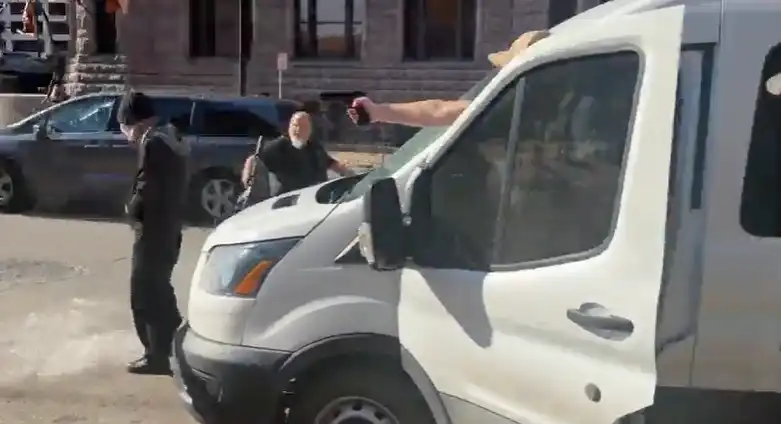
The Hennepin County Attorney’s Office is charging two men described as bounty hunters for allegedly threatening anti-ICE protesters and residents with replica firearms during a March 3 confrontation in downtown Minneapolis.
“One of the bounty hunters pointed what looked like a Glock and gun at civilians,” said Hennepin County Attorney Mary Moriarty in a video statement posted on social media Tuesday. “Another bounty hunter discharged a rifle-style weapon at the scene, which was determined to be firing less lethal ammunition. This is reported to investigators that the weapon’s appearance was indistinguishable from real firearms.”
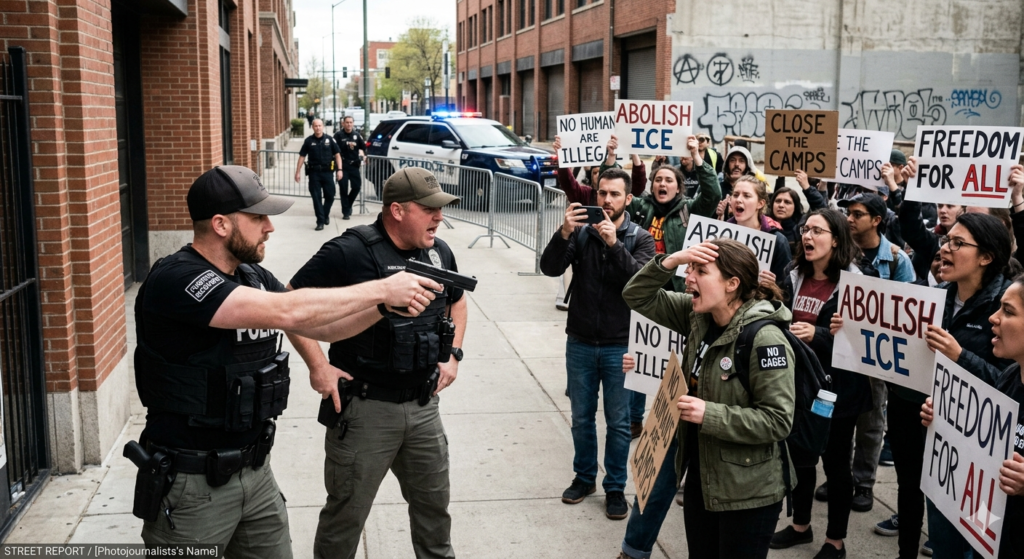
According to the charges filed Tuesday, the bounty hunters traveled to Minnesota from Oklahoma, where both James Reginal Willis and Garrett Christopher Willis are based. They’re each charged with making threats of violence with reckless disregard and brandishing replica firearms, both of which are felonies.
“This was disturbing, unlawful behavior that terrified the civilians involved, and shocked a community that was still reeling from the federal government’s occupation,” said Moriarty.
According to the complaint, James Reginal Willis told investigators that videos of the March 3 incidents, which made the rounds on social media, made the situation look “way worse” than it really was. He said his team had pistols modeled after Glocks that fired pepper balls and two pepper ball assault rifles.
Investigators didn’t find video evidence that backed up the bounty hunters’ claims that observers at the scenes threatened to “scalp” them or shoot them in the head. Both men are scheduled to make their first appearances in court on April 21.
Hours before the standoff outside the county jail in downtown Minneapolis, ICE observers first noticed the van parked on a street in a residential area of south Minneapolis.
It had deeply tinted windows and a decal for a plumbing business with a non-functioning phone number. Observers said they were told by a Minneapolis police officer at the scene that the men were bounty hunters and that the observers should keep their distance.
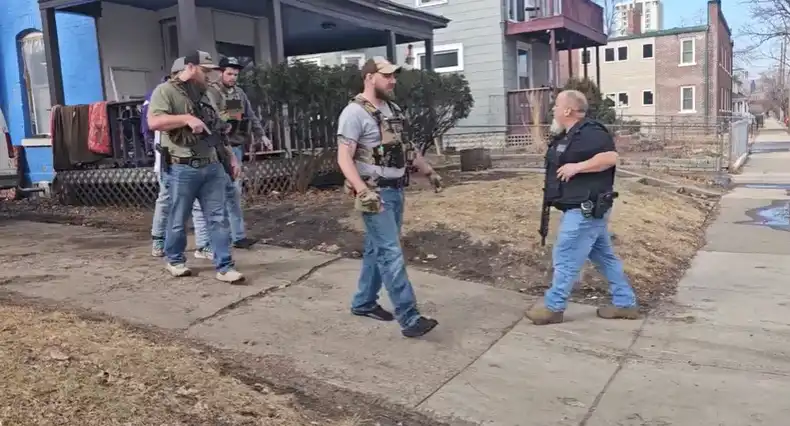
Violet, who asked to be identified by her first name to avoid possible retaliation from federal authorities, peeked into the van’s windows, and said a man popped out and took her photo.
“I heard the van doors slide open, and these guys just burst out screaming,” Violet said. She started recording and blew her whistle, which is used by observers to notify neighbors of ICE’s presence. A neighbor told MPR News that she looked out her window and saw an unmasked man in a bulletproof vest leading someone out of a neighboring house in handcuffs.
Violet said one of the men squared off with her and the other observer at the scene in south Minneapolis, threatening them. Videos shared with MPR News show one of the men crossing the street and pulling his weapon on an approaching driver until the driver backed up their vehicle. Minneapolis police say they didn’t receive any 911 calls from that location.
Witness Flannery Clark was standing on a public sidewalk in downtown Minneapolis when she saw a man in plain clothes pull out a pistol, point it at people blowing whistles, and pull the trigger. The gun didn’t fire, but she and others gathered at the scene were shaken.
“My first instinct, of course, when people had whistles, was that it was ICE,” Clark said. “When I talked to the other folks who were there, they clarified that they believed [the men] were bounty hunters.”
The man who threatened Clark and other observers with the pistol got back into a van with tinted windows as his bearded colleague warned people to get back and fired pepper balls at their feet. Video provided by witnesses and first published on social media shows the van bumping one of the observers as it merged into traffic.
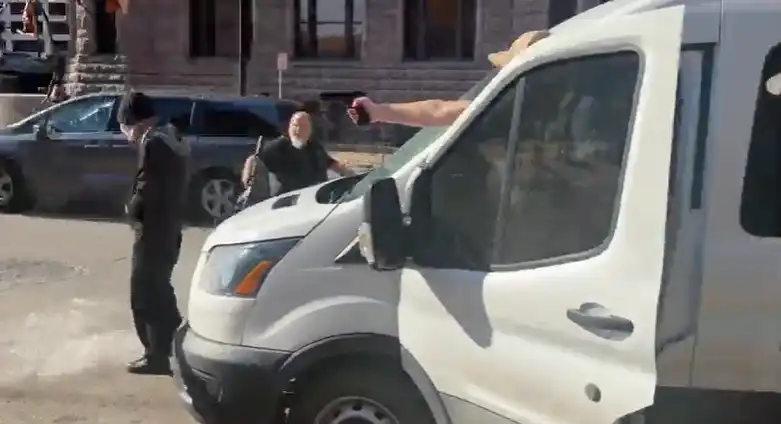
For Clark, the experience brings home the uncertainty of this winter in Minnesota, of not knowing who groups of men with guns are, and of the frustration of feeling like local authorities aren’t willing to help.
“I did find it pretty shocking,’” Clark said. “Just random men in vests with guns could point their guns at people on the street who weren’t doing anything.”
The incidents sparked concerns that federal agencies that surged into the state this winter might be shifting tactics to contract with private parties for immigration enforcement efforts.
The charges make no mention of any relationship with ICE or any other federal agency. But rumors of bounty hunters have abounded among ICE observers in the Twin Cities, including the suburbs, since the surge started in December. MPR News was not able to confirm those incidents.
However, at least one habeas corpus filing on behalf of an immigrant arrested in Minnesota during the surge describes an arrest by alleged bounty hunters. A Waseca resident and El Salvadoran native was stopped in a vehicle by “people who claimed they’re not ICE” on Feb. 12.
“Those people then contacted ICE and a truck appeared which was driven by ICE agents,” according to the court filing. He “saw a check or some form of payment change hands between the ICE agents and the civilians who initially pulled him over.”
An attorney representing the man who was arrested declined comment. Their client has since been released from the Sherburne County Jail on a judge’s orders.
Federal prosecutors in the man’s case didn’t address the allegations that they contracted with bounty hunters, but said in a response to the habeas filing that the arrest was made with an administrative warrant, which does not require a signature by a judge and which legal experts have criticized. Prosecutors said ICE didn’t say whether the warrant was issued before the man’s arrest or who it was signed by.
ICE did not respond to requests for comment. Although the federal agency previously told the Minnesota Star Tribune that rumors they employed bounty hunters were part of a smear campaign. But some national journalism organizations have reported that the notoriously opaque Department of Homeland Security already has programs in place for exactly these sorts of contractors.
An October report in The Intercept said ICE had put out a document to contractors soliciting interest in a program where bounty hunters could receive “monetary bonuses” for tracking down the agency’s targets and later reported that contractors were set to receive more than $1 billion by the contract’s end in 2027.
Wired reported in November that leaked documents show ICE expanding a program to contract with private surveillance firms to outsource immigrant tracking.
Bounty hunters were present on public streets before the federal surge into Minnesota started in December. They’re a fixture in the criminal justice system in the state, and often responsible for turning over people who jump bail.
A spokesperson for the Minnesota Department of Commerce, which oversees bond agents but not the bounty hunters they sometimes contract with, said the agency hasn’t received any complaints about bounty hunters in the state.
No agency in the state oversees the licensing of bounty hunters, but they are subject to the same laws as other citizens.
When Hennepin County Attorney Mary Moriarty announced the charges against the two bounty hunters, she also asked legislators to pass new laws requiring licensing, bonding and training for bounty hunters.
“Passage of this legislation would make our communities safer,” Moriarty said. “Our office will continue doing its part in holding bounty hunters accountable for unlawful actions.”